The Alignment Index
Find the gap between AI confidence and capability.
 Alignment Index: by teamSample report
Sample report with made-up teams and figures.
Trusted by 1,000+ organisations










The Alignment Index is an anonymous, workforce-wide diagnostic that measures how confident people feel about AI and tests what they can actually do in realistic work scenarios
It tests judgement, not usage:
- What is safe to paste into a public AI tool
- Whether a source the AI gave them is real
- Whether an AI-written summary contains an error
- When output needs a human check before it goes anywhere
From a sample report
How people feel about AI right now
Illustrative figures
What we measure
Attitude
How people feel about AI: trust, security and willingness to engage.
Capability
What people can show, scored from work scenarios, never from self-confidence.
Perceived alignment
Whether your people believe leadership is handling AI in their interest.
AI usage
What people are actually using AI for at work, and how.
Honest disclosure
Whether people have misused AI. Anonymous, so they answer truthfully.
What's in the report
- How people feel about AI right now
- The gap between what people believe they can do and what they demonstrate
- Where the risk sits, and which behaviours drive it
- Capability gaps by topic, mapped to specific training
Alignment Index: baseline reportSample reportRun it the way that suits you
With Foundations
Measure, put people through our twelve Foundations lessons with Ada, then measure again on the same questions to show what changed.
Alignment Index4 of 12A client sends a contract and asks for a summary by noon. What do you do first?
On its own
Run it alongside the training you already have, to see where to point it.
Either way, it runs as a link or inside your LMS. Measure again after training and watch the gap close.
More than a survey
Surveys tell you how people feel. Your LMS tells you who finished. The Alignment Index asks how people feel and tests whether they can do the work, in one short check-in.
Attitude
Trust, security, willingness to engage, and faith in leadership.
Honest disclosure
No names, emails or IDs, so people say what they really do with AI.
Tested capability
Real work scenarios beside a self-rating, so you see where confidence outruns skill.
Alignment Index: honest disclosureSample reportSample report with made-up figures, to show the format.
What honest disclosure looks like
Example from a sample report. Share of the workforce, and where training addresses it.
Alignment Index: honest disclosureSample reportSection 4 · Risk behaviours
| Behaviour | Share of workforce | What it puts at risk | Addressed in Foundations |
|---|---|---|---|
| Used a public AI tool with client-identifiable information in the last 60 days | 34% | Client data held by a tool you don't control. | Data privacy and security essentials |
| Has not told their manager about their AI usage | 28% | AI use you can't see, support or govern. | Your organisational AI policies and governance |
| Acted on AI output without verification | 19% | Made-up facts reaching clients and decisions. | Hallucinations and confabulation |
| Pasted internal documents into a public tool | 11% | Confidential plans and IP leaving the business. | Data privacy and security essentials |
| Used AI for client deliverables without disclosing it | 7% | Client trust, and contracts that require AI use to be declared. | Ethics, bias and responsible AI |
Sample report with made-up figures.
Built to tell you where you stand
Mapped to frameworks your board already recognises
How we measure
Belief and evidence are captured separately
Self-ratings alone can't tell you who is capable (Dunning-Kruger).
Scenarios, not recall
Each question asks for a judgement in a real work situation (Bloom, the forgetting curve).
Nothing is free text
Ratings and fixed choices only, so no personal information gets in.
Mapped to





Anonymous by design
People only answer honestly when they know it can't come back to them.
We never learn who anyone is
No name, email, user ID or hidden token. It isn't personal data.
It can't be used against individuals
Never used to bar people from promotion, performance or disciplinary decisions. Barred by contract.
You see groups, never people
Groups below the agreed minimum size are never shown on their own, so no one can be picked out.
Data stays in the UK
Held in London for 13 months. No AI vendor has access.
Assemble You is Cyber Essentials Plus certified. Full DPA available.
The AI capability illusion
We asked 1,000 UK workers in full-time employment to rate their AI skills. Then we tested them on eight everyday work scenarios.
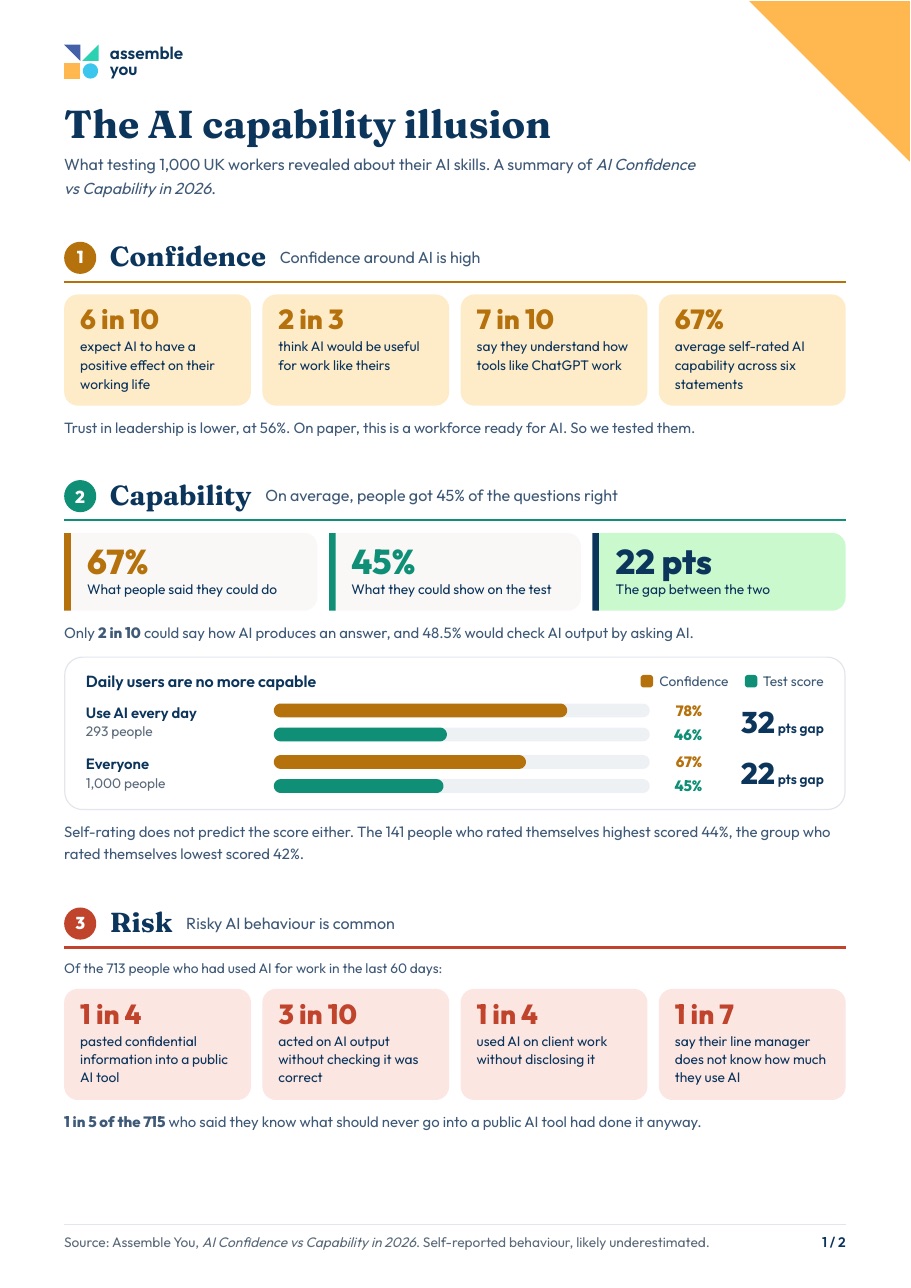
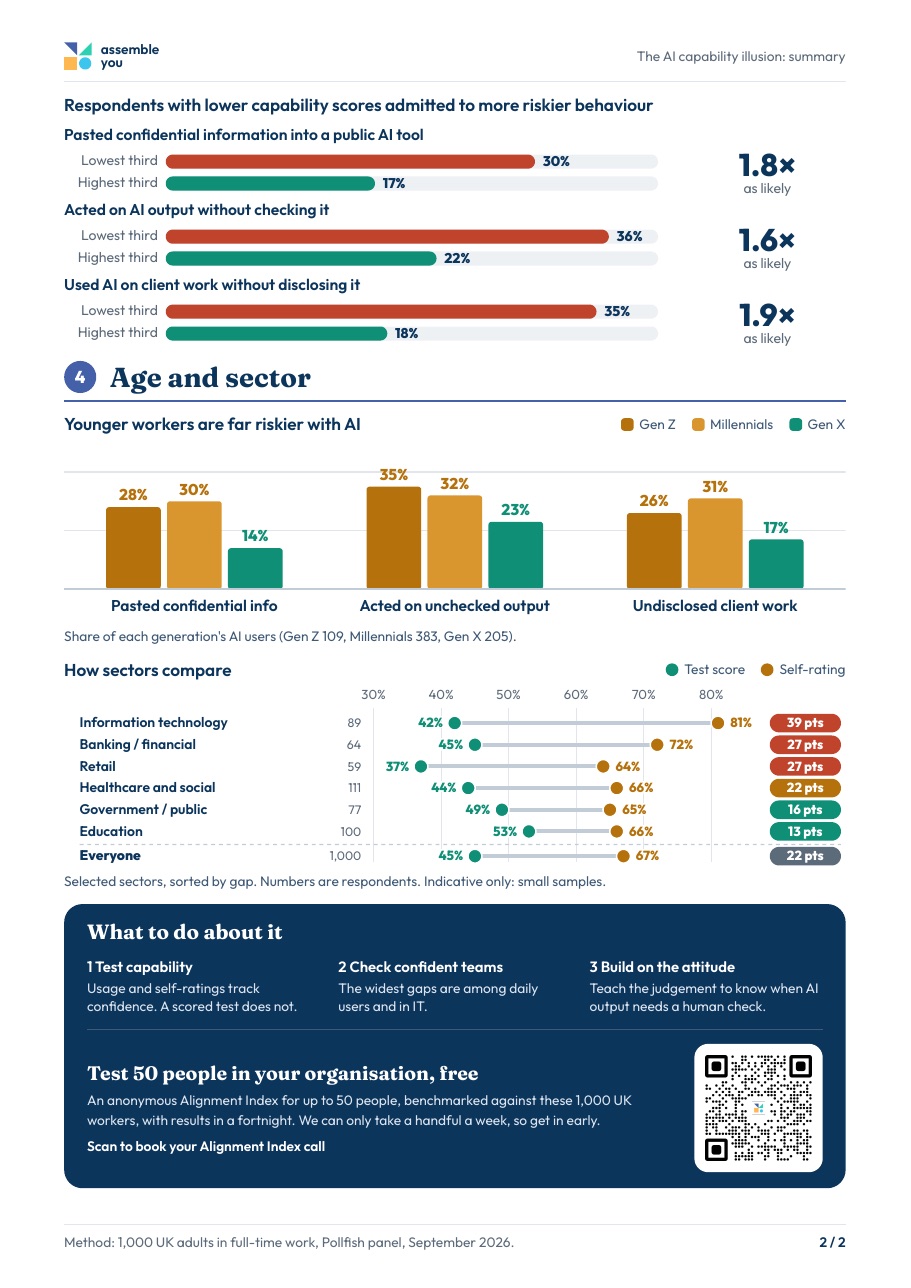
What people said they could do, against what they scored. A 22‑point gap.
Seven in ten said they understand how tools like ChatGPT work. Two in ten could show it.
Had put internal or confidential information into a public AI tool.
Why organisations use Assemble You instead of building their own
A survey you build in-house
- HonestySent by the employer, so staff answer with that in mind
- What it measuresSelf-reported confidence
- RiskRarely asked, rarely answered truthfully
- StandardYour own questions
- BenchmarkNone
- Next stepA spreadsheet of results
- DataSits in your HR systems
The Alignment Index
- HonestyRun by a third party that holds no identifiers, with a contractual ban on individual use
- What it measuresAttitude and scenario-tested capability, scored separately
- RiskRisk behaviours reported as a share of your workforce
- StandardMapped to the EU AI Act, NIST, UNESCO, WEF, ICO and ISO
- BenchmarkCompare your people with 1,000 UK workers
- Next stepA report that says where to focus, plus training to close the gap and remeasure
- DataNot personal data. Held in London, never leaves the UK, no AI vendor access
FAQs
Who is the free 50-person Alignment Index for?
Any organisation that has rolled out AI tools, or is about to, and wants to know whether its people can use them safely and well. We're confident the results will be useful, so we'll prove it on up to 50 of your people for free.
You'll need more than 10 people taking part. Below that, responses could be traced back to individuals and the Index would no longer be anonymous.
What do we receive from the free test?
A report showing how your people feel about AI, the gap between what they believe they can do and what they demonstrate, where risk sits and which behaviours drive it, and capability gaps mapped to specific training.
Results are benchmarked against the 1,000 UK workers we tested and arrive within a fortnight. We then take you through them on a debrief call.
Who should take part?
A cross-section of your workforce, not only the AI enthusiasts. A mix of departments, sites and seniority gives the clearest picture of where confidence and capability split.
You'll need more than 10 participants to keep results anonymous.
How long does the assessment take?
About ten minutes per person.
Is the test genuinely anonymous?
Yes. We collect no name, email, user ID, employee number or hidden token, so responses can't be traced to anyone.
Questions use ratings and fixed choices only, with no free text, so personal information can't get in. The Index is run by Assemble You as a third party, not by your organisation.
Can managers see individual responses?
No. You see groups, never people. Any group smaller than the agreed minimum is combined or suppressed.
Our contract bars use of results for promotion, performance or disciplinary decisions.
What is the benchmark?
Your results are compared with 1,000 UK workers in full-time employment whom we tested in 2026 for our report, The AI Capability Illusion. On average they rated their AI skills at 67% but scored 45% when tested, a 22-point gap.
What does the confidence-capability gap tell us?
Where people's confidence and capability don't match, and in which direction.
Where confidence is higher than capability, people are more likely to trust unchecked output, cite invented sources or put confidential data into public tools. That's where risk sits.
Where capability is higher than confidence, people can do more than they think. They may be holding back from using AI, and that's value your organisation isn't getting. These people need support to build confidence, which the AI Confidence Method also provides.
Either way, the gap shows which teams need attention first and which topics training should cover.
What happens after the 50-person test?
We take you through the results on a debrief call. You can then run the Index across your wider workforce, add Foundations training to close the gaps, or use the findings to direct training you already have.
Is there a sales obligation?
No. The report is yours to keep. We do hope it impresses you enough that you'll want to keep working with us.
Can the Index run through our LMS?
Yes. It runs as a module inside your LMS or as a standalone link.
How does this relate to the AI Confidence Method?
The Alignment Index is the Measure stage of the AI Confidence Method.
Run it before Foundations to find the gaps, then again afterwards on the same questions to prove what changed. It can also be used on its own.
Can I run the Alignment Index without Assemble You's AI training?
Yes. You can run a single Alignment Index, or several over the year to track change.
Choose a one-off purchase or our great-value subscription. Contact sales to find out more, or book a call to go through the options with one of the team.
Test 50 people in your organisation, free
See how your people compare with the 1,000 UK workers we tested. Limited spaces available.